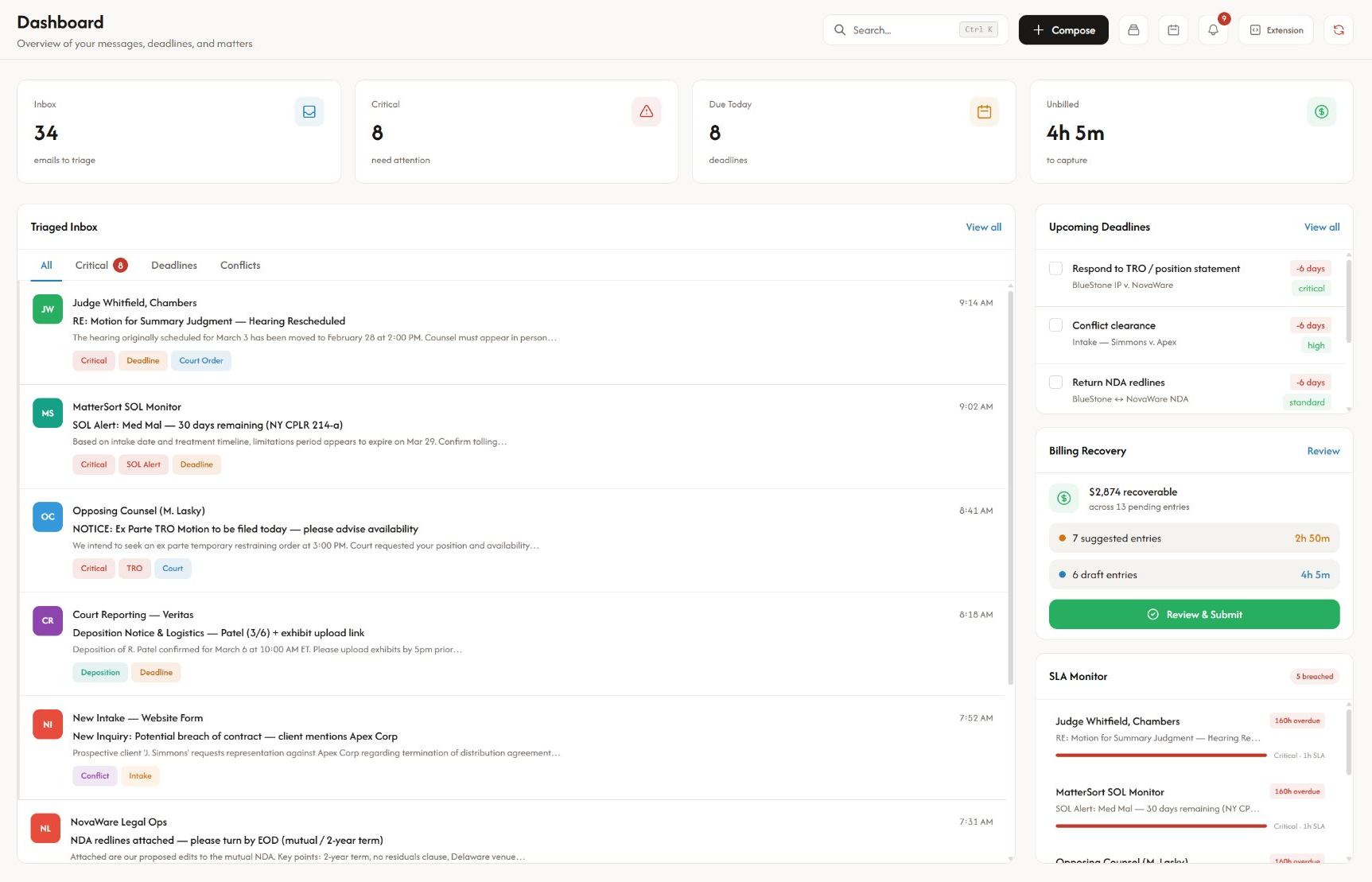
Mattersort reads every incoming message — email, PACER alert, court notice, portal message — classifies it by legal urgency, routes it to the right matter, and recovers the billable time you're losing to triage.
Book a Demo
Adjust the sliders to match your situation. Every number here is conservative — most attorneys recover more.
Every day, critical communications are buried under volume. Not because attorneys are careless — because email wasn't built for legal work.
A statute of limitations notice sits at message 47. You read it — just not in time.
12 billable hours weekly per attorney lost to sorting and routing. At $400/hr, that's $2,400/week walking out the door.
Trace back to a missed deadline. Not negligence — volume. The inbox had no idea what mattered most.
Follow-up emails, call summaries, research threads — hours disappear from the timesheet with no system connecting work to bill.
A solo immigration attorney receives 140 emails on a Monday. Buried in page 3 of her inbox is a USCIS Notice to Appear — triggering a 30-day response window. If missed, automatic removal proceedings begin. Without triage, she doesn't open it until Wednesday.
USCIS notice ingested at 9:14am Monday via email integration
Legal NLP parses "Notice to Appear" + "30 days from date of service" — flags Critical immediately
Attorney sees it at inbox top by 9:15am — deadline auto-calendared, Matter #1847 updated in Clio
Escalation ladder armed: if unopened by 11am, partner receives SMS
Client's removal proceedings avoided. Two-day delay eliminated. One malpractice claim that never happened.
An associate spends 45 minutes reviewing opposing counsel's document production. Billable — but without a prompt, it never makes the timesheet.
Mattersort detects thread involves document production for active matter
Time-on-email tracked from open to close — 47 minutes captured
LEDES-formatted draft entry generated: "Review of opposing counsel document production"
One-click push to Clio. Entry logged before memory fades.
$312 in billable time recovered from a single email session.
A discovery response deadline is embedded in paragraph 3 of a friendly-toned email. Easy to skim past.
Email from opposing counsel flagged for deep parse
NLP extracts "responses due by March 28" — 7-day window
Deadline pushed to calendar, priority elevated to High
Reminders at 72h, 48h, and 24h before deadline
Discovery deadline met. Sanctions motion avoided.
John Smith has an estate plan and pending litigation. His accountant's email references both.
Email mentions estate assets and litigation discovery
Dual-matter relevance identified via entity extraction
Email routed to Matter #3201 (Estate) and #3207 (Litigation)
Both assigned attorneys notified with context tags
Cross-matter intelligence without manual sorting.
A temporary restraining order request arrives at 4:47pm Friday. The assigned attorney is offline.
Email flagged Critical — "temporary restraining order" + "emergency hearing Monday 9am"
Attorney doesn't open within 15 min — push + SMS sent
Unacknowledged at 5:15pm — backup attorney notified
Backup reviews, prepares for Monday hearing
Emergency covered. Escalation ladder worked as designed.
A client files a bar complaint claiming the firm was unresponsive.
Bar counsel requests communication timeline
Audit trail exports every action — timestamped
Response-time: 4.2-hour avg vs. 24-hour SLA
Evidence submitted. Complaint resolved.
The audit trail that built itself.
Four-tier urgency matrix — Critical, High, Standard, Low — calibrated to legal consequence, not email metadata. Court orders and response-window messages surface first, always.
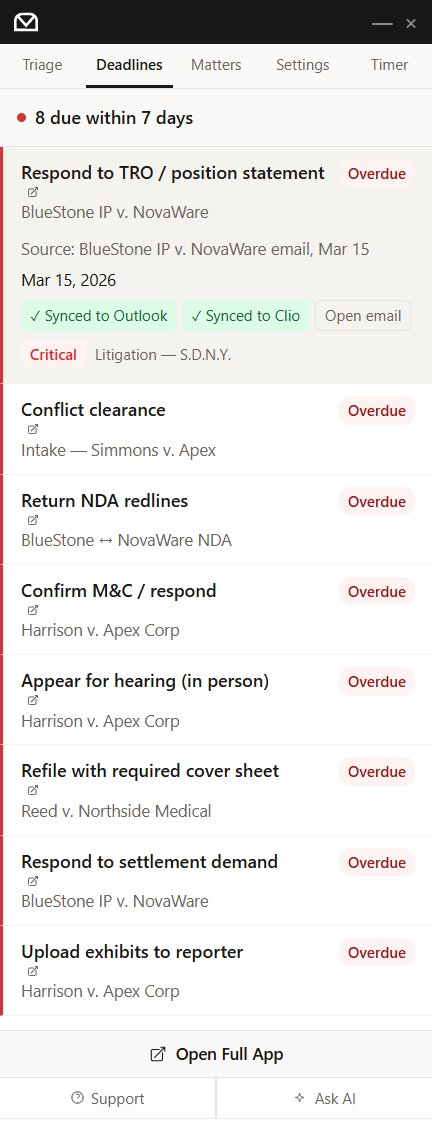
Reads scheduling orders, PACER alerts, opposing counsel letters, and USCIS notices for dates and windows. Pushes directly to your calendar and logs to the matter file.
Acknowledgment-based escalation: if a Critical deadline message isn't opened within your configured window, it escalates — email, then text, then backup attorney. No more Friday 4:47pm TROs going unread.
"John Smith" routes differently depending on whether it's his estate plan or his active litigation. Routing respects matter teams, delegation protocols, and attorney coverage — not just contact history.
Scans every incoming message for conflict indicators before you open it — flagging opposing party names in real time.
Detects "litigation reasonably anticipated" language and prompts litigation hold initiation automatically.
Generates 3 draft variants for routine messages — pulling from matter context and your writing style.
Surfaces flagged threads when a client hasn't heard from you in 24h, 48h, or 72h.
Prompts time logging after billable emails. LEDES-formatted entries pre-built from email context.
AI-generated time entries pre-formatted to LEDES 1998B/2000. Pushes directly to Clio or MyCase.
Mattersort connects to your existing tools — no rip-and-replace required.
Your data never leaves your environment. Mattersort deploys directly on your firm's own servers or private VPS — no shared cloud, no third-party data exposure.
Our architecture, engagement terms, and audit trail satisfy the reasonable confidentiality standard. Reviewed by legal ethics counsel before any attorney used the product.
Every classification, routing decision, and attorney action is timestamped and logged to the matter file. Exportable for bar counsel submissions and malpractice defense.
Currently pursuing SOC 2 Type II certification. All processing within US data centers — no offshore routing. On-premise deployment available for firms with elevated data sovereignty requirements.
Join super attorneys who open their inbox each morning to a sorted, prioritized, legally-aware view of exactly what needs their attention — and nothing that doesn't.
Book a Demo